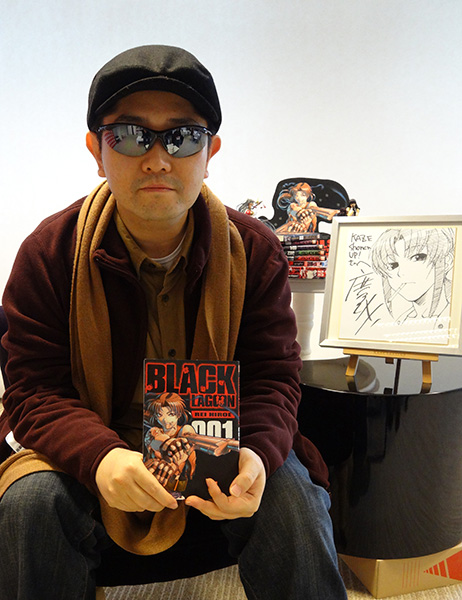
 Rei Hiroe (広江 礼威 Hiroe Rei), born December 5, 1972, is a Japanese manga artist who is mostly known for his popular manga Black Lagoon. When he is working on doujin comics he goes by the name Tex-Mex. Hiroe's manga were originally published by Kadokawa Shoten in the 1990s but none were complete. As a response, Hiroe transferred to Shogakukan in the early 2000s, where all of his manga released before Black Lagoon were republished and re-released.
Early life and career
Hiroe was born on December 5, 1972 in Japan.[1] As a child, he grew up in Ōiso in Kanagawa Prefecture.[2] Hiroe's entry into drawing began in his second year of middle school when his friend Kotetsu Yamanaka, an illustrator and colorist for Black Lagoon, recommended that he start drawing. After graduating from high school, he did not pass his university entrance exams, so he got a job at a game company after a friend of his at an arcade that he frequented invited him for work knowing that he had drawing skills. Briefly working at his first company and then another game company, Hiroe then got a job at Monthly Comic Comp, where he published his first manga Hisuikyō Kitan. However, as he continued writing the series before it could progress further, the magazine company ceased publishing, thus discontinuing his series.[2]
Hiroe did not have any contacts at other publishers, so he resumed working on doujinshi for some time. Eventually in 1998, he was able to publish his first commercial work SHOOK UP!, which was cancelled after a brief run due to its lack of popularity. Immediately afterward, Hiroe wrote Phantom Bullet, which was influenced by his interest in the Cthulhu mythos as a child and wanting to draw a dark horror action story. He believed that the story became rough and wanted to work on something else.[2] Thinking that he was done with commercial magazines, Hiroe worked for a new editor with whom he got along well, and he began writing the Black Lagoon manga as a one-shot, which was published in March 2001 in Sunday GX's April 2001 issue.[3]
Influences and style
In various interviews, Hiroe stated that the idea of Black Lagoon came from doing research on medieval pirates as well as learning about the rise in piracy in the early 1990s in the East China Sea. He figured that he could make a modern story about such pirates and do something Quentin Tarantino-esque.[4] He is a fan of the Wild 7 manga by Mikiya Mochizuki, and he additionally enjoys the works of Akihiro Itō (Geobreeders)[5] and Kenichi Sonoda, a manga artist famous for the manga series Gunsmith Cats.[6] Hiroe has also enlisted the help of Seiichi Shirato and Jūgo Tsukuda for technical advice.[7]
Furthermore, he has acknowledged that Black Lagoon is greatly influenced by American works, authors and filmmakers,[4] including Quentin Tarantino, James Ellroy (his favorite novelist),[8] Sam Peckinpah,[5] Robert Rodriguez,[9], H.P. Lovecraft,[3] and Robert B. Parker.[10] Hiroe once said that he learned how to create the atmosphere of Black Lagoon based on the works of Stephen King.[8] Another novelist who has influenced him is Yoichi Funado.[11]
Hiroe has stated that he reads books on anything that catches his attention, adding that he prefers the original source over the internet but will use the latter if needed.[7] For gun designs, he has remarked that the guns are not original designs with the exception of Roberta's tommygun in "El Baile de la muerte."[4] His great knowledge and research on the subject of firearms has led him to buy encyclopedias on the subject in order for his work to benefit from more precise details.[12] In addition to Quentin Tarantino films, Hiroe has been influenced by the Hong Kong triad films of the 1980s and 1990s such as films involving the work of John Woo and Chow Yun-fat.[9] Hiroe does not like the moe style seen in anime and manga, stating that he enjoys making robust women instead of cutesy characters who are attracted to the main character.[4]
Black Lagoon characters and story
Regarding the reason that Black Lagoon takes place in 1995, Hiroe has stated:
"When I started [Black Lagoon], I thought we were entering a new era after the end of the Cold War. Of course, that new era brought new problems, but I thought those problems would help shape the new order. By having it take place in 1995, I wanted to show a volatile era of chaos. To create characters who could only live in chaos and will eventually be eliminated as the world becomes more organized. But it turns out that the real world is so chaotic—there is no order. It's one chaotic mess after another!"[7]In the same April 2021 interview, Hiroe spoke about his conception and writing of the Russian mafia:
"Depicting the ghost of the Soviet Union was a big thing for me. The Russian mafia was most active in the nineties too, so I wanted to incorporate that. People became outlaws as the Soviet Union collapsed. That was fascinating to me. Like in Battles Without Honor and Humanity. As I watched the Afghan invasion and the collapse of the Soviet Union in real time, I figured there had to be people like that."
On Revy, Hiroe stated that Revy's image was based on the image of a strong Chinese girl. Revy's tribal tattoo was inspired by George Clooney's character's tattoo in the 1996 movie From Dusk Till Dawn, saying that he thought it would be cool if a woman had a tattoo like that. Another inspiration for Revy was thinking that Sarah Connor (from the Terminator franchise) would look cool wearing a black tank top.[4] Furthermore, he first wanted Revy's dominant character trait to be impulsiveness, and he made her grow up in a criminal environment so that her values were totally different from ordinary people.[12] Revy's custom pistol was originally going to be a Taurus model, but Hiroe decided to make it a Beretta instead due to lacking detailed materials on the item.[10]
Regarding Hiroe's reason of making Revy a Chinese-American character, he stated:
"Ethnically, I wanted Revy to be a minority. And her look isn't [Caucasian] but rather [Asian]. I thought that would make it easier for the Japanese readers to identify with her. Easier than if it was a white woman going ballistic. If she's a Chinese-American character, she may look Chinese, but her upbringing and her roots would be American. It's interesting when there's a gap between the way she looks and her way of thinking. People like that aren't really tied down to a region, like they're rootless wanderers. She's different from normal people so I thought she'd make for a more interesting character. And obviously, she probably faces discrimination in her life. Taking all that into account, I thought her character would stand out more."[13]
On Rock's creation, Hiroe has mentioned that he created Rock because his staff recommended that he create a character who shared the audience's point of view.[8] Additionally, he originally thought of including a Cuban exile who participated in the failed CIA-backed Bay of Pigs invasion as another Lagoon Company member who would be a mechanic. Hiroe decided against adding the character because he did not want the man's backstory to take away the spotlight from Dutch's past.[10]
On Balalaika, the reason Hiroe made a woman the head of Hotel Moscow: "Simply because I thought it’d be better to see a woman's butt. Her scars are totally my fetish too. I've loved female characters with scars since I drew Grimalkin von Stieber in Hisuikyokitan."[7]
On Mister Chang's creation and portraying the Hong Kong Triad, Hiroe has stated: "He [Chang] was only a side character that appeared with the Council in the Twins arc, but he became such an important character soon after. I casually drew him exactly like Chow Yun-fat and then he took on a life of his own... I even read books on the Chinese mafia to build an organizational chart and stuff."[7]
On Shenhua's accent, Hiroe said that her way of speaking came "from a lady who works at a Chinese restaurant in [Hiroe]'s neighborhood. I didn't want her talking like a cliché Chinese character, so I came up with altering her phrasing. Junichi Inoue, who wrote A Chinese Wife and an Otaku Husband, said it sounded authentic. That made me happy." In addition, Rei Hiroe's editor stated that Shenhua was originally meant to have an androgynous appearance, but she ended up being a woman. Hiroe also remarked that Shenhua, Lotton and Sawyer are "Black Lagoon
Concerning how he wants to conclude the manga, Hiroe has stated that he is counting on the occasion of the transition from the 20th century to the 21st century, aiming to create an impactful event that will change the plot of Black Lagoon.[12]
Black Lagoon collaboration and spinoffs
For Black Lagoon, Hiroe has collaborated with Gen Urobuchi, who wrote the first and second Black Lagoon light novels Shaitane Badi (2008) and Ballad of the Sinful Wizard (2011) while Hiroe did the illustrations for both light novels. In 2019, the first official spinoff series Dismemberment Galore! The Gore Gore Girl was released, which stars Sawyer the Cleaner as the titular protagonist. It is written and illustrated by Tatsuhiko Ida with supervision by Hiroe.[14] In 2022, the second official spinoff series Eda Initial Stage was released, which stars Eda as the titular protagonist. It is written and illustrated by Hajime Yamamura with supervision by Hiroe.
Other works
Manga
- Hisuikyō Kitan (1992–1994)
- Shook Up! (1998–1999)
- Phantom Bullet (2000)
- Black Lagoon (2002–ongoing)
- 341 Sentōdan (2019–ongoing)
- Black Lagoon: Sawyer the Cleaner — Dismemberment Galore! The Gore Gore Girl (2019-ongoing) — Supervision & original characters
- Black Lagoon: Eda Initial Stage (2022-ongoing) — Original characters
Anime
- Black Lagoon (2006–2011) — Original creator
- Re:Creators (2017) — Original story, concept and character designer
Other
- Black Lagoon: Shaitane Badi (2008, illustrations)
- Black Lagoon 2: Ballad of the Sinful Wizard (2011, illustrations)
- BLACK LAGOON Illustrations Onslaught (2021)
- Reighborhood! Rei Hiroe Illustrations (2009)
References
- ↑ Author profile (Gekkan Sunday).
- ↑ Febri Vol. 45 (Part 1), November 2017; reprinted in April 2021.
- ↑ Febri Vol. 45 (Part 2), November 2017; reprinted in April 2021.
- ↑ July 2010 Anime Expo interview (YouTube).
- ↑ February 2017 interview (Otaku USA).
- ↑ July 2011 APA interview (YouTube).
- ↑ Loser's Horizon column in the April 2021 issue of Monthly Sunday Gene-X.
- ↑ Otaku USA Vol. 5, no. 2, August 2011.
- ↑ June 2016 Ani-Gamers interview (Ani-Gamers).
- ↑ Loser's Horizon column in the August 2003 issue of Monthly Sunday Gene-X.
- ↑ April 2025 interview (MEQRI).
- ↑ February 2013 interview (Manga Sanctuary).
- ↑ Black Lagoon Volume 9 (VIZ version) interview.
- ↑ According to Tatsuhiko Ida, Hiroe's involvement in the series is checking names and reviewing the completed manuscripts of each chapter. Tweet from July 2020.
External links
- Rei Hiroe on Twitter/X